
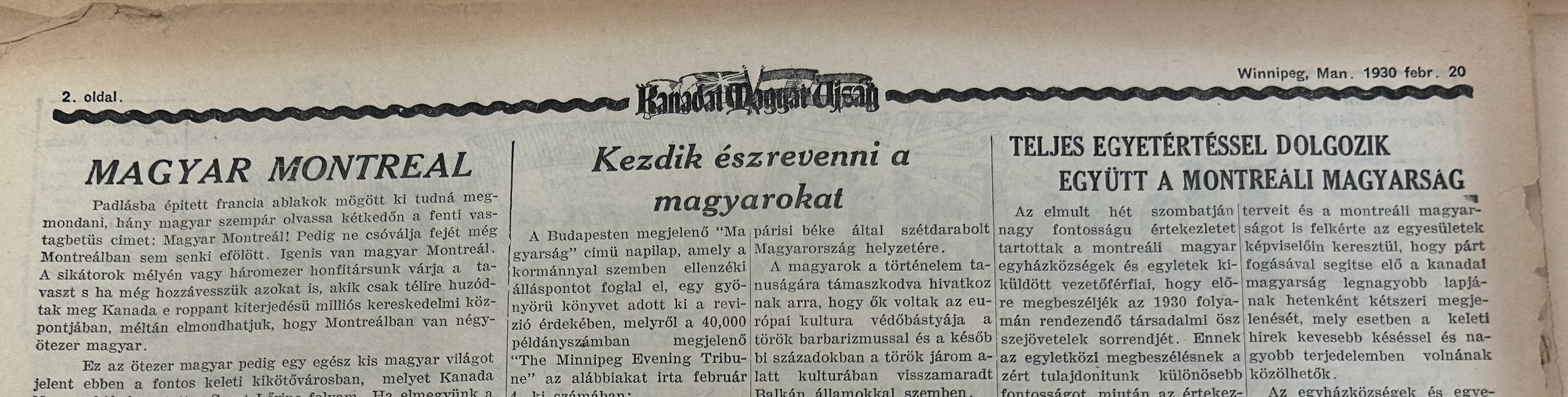
Visitors to the website, users of our map, can get to know "Hungarian Montreal", a city that has been home to many organizations, initiatives and events over the past 100 years, through various waves of immigration, aimed at supporting Hungarian immigrants, preserving Hungarian culture, strengthening Hungarian identity and connections. The map highlights the unique heritage of the Hungarian diaspora in Montreal and seeks to preserve it for posterity. It provides an insight into the past and the present through the lens of both Hungarian and Canadian history.
A hundred years ago, prior to the 1920s, Montreal was probably not seen as a likely place for a thriving Hungarian diaspora. Prior to that, the main destination for Hungarian emigration was the United States, with Hungarians arriving (if at all) mainly to the western, so-called prairie provinces of Canada (see, for example, the writings of Nándor Dreisziger and M.L. Kovács or Carmela Patrias ). After World War I, the emigration fever continued in the 1920s, with many Hungarians continuing to seek a better life overseas. However, the United States virtually closed its doors to mass immigration from our region with the introduction of immigration quotas in 1921 and 1924 (for more information click here (in Hungarian)). At the same time, however, Canada's immigration policy also changed, giving Hungarian immigrants the opportunity to see Canada as a possible (permanent or temporary) destination.
As a consequence, the number of Hungarians arriving in Canada increased significantly, and although the goal of Canadian migration policy was still to attract immigrants to the West (see e.g., Valerie Knowles' book), many ended up in the big cities of Central or Eastern Canada. Thus, Montreal also began to play an increasingly important role within the Canadian diaspora.
The growth is also clearly illustrated by population figures. According to the 1921 Canadian census, there were only 67 Hungarians living in Montreal (some of the various census data are available online). As a result of the first major wave of migration, this number had risen to 3,000 by 1931, which meant that the city was by then home to the largest Hungarian community in the country, with a population that surpassed the earlier centres in both size and importance (Dreisziger, 103), especially considering that there were probably more Hungarians living in the city than that. Due to the Great Depression and the subsequent stricter Canadian immigration laws (see Knowles 142-145), this number mostly stagnated, and the 1941 census reported that 3,457 Hungarians lived in the city due to new arrivals from Hungary (mostly family reunification) and other parts of Canada (Dreisziger, 144).
Jenő Ruzsa wrote the following about Montreal, the "Paris of Canada" in 1940:
"We can only speak of a significant Hungarian group after World War I. There are a few families from the pre-war period, but large-scale immigration only started after 1925. Even in 1926 there were hardly 20-25 families. Over the next four years, however, the number of Hungarians increased rapidly. At the beginning of the 1930s, there were even reports of 8-10 thousand Hungarians. According to conservative estimates, there are about 5,000 Hungarians living in Montreal today
…
All the regions of the home country are represented in Montreal, but most of them are from Abaúj, Borsod, Zemplén, Szabolcs, Szatmár, Bereg and Ung counties. Among the Hungarians from the many occupied territories there are also several hundred Szeklers. Most of them belong to the agricultural working class, with many small landowners among them. There are also a good number of industrialists and craftsmen. A relatively large number of graduates from higher education and artists" (285-286).
The community revived after World War II with the arrival of a new group of immigrants, but the 1951 census shows a decline: the city had 3,093 Hungarians. By this time, Toronto had taken over as the most popular destination for immigrants, with Montreal dropping to second place.
The largest waves of Hungarian immigration to Canada arrived in 1956 and 1957. In terms of country of birth, 32,929 Hungarians were living in Canada in 1951, which increased to 72,900 by 1961, and the total Hungarian population rose from 60,460 to 126,220. While many of the new arrivals went to Ontario, and more specifically to Toronto, the second most popular destination was the province of Quebec, especially Montreal. The increase was also visible in the following census figures. Although in 1961 the Hungarians were already classified as 'other European', making it difficult to give precise figures, the census shows that the Hungarian-speaking immigrant population of the wider Montreal urban area was 11,980, of whom 7,127 immigrants arrived between 1956 and 1961. This rapid and spectacular growth created a Hungarian community of 20,000 in Montreal. Although such a large wave did not arrive later and many moved to other cities, such as Toronto, in the 1970s and 1980s, Hungarian immigrants continued to arrive (not only from Hungary, but also to a significant extent from areas inhabited by Hungarians in neighbouring countries). According to 2016 figures, there are 28,000 Hungarians living in the province of Quebec, of whom nearly 9,000 are first-generation immigrants (44% arrived before 1981, Statistique Canada).
These Hungarians, who arrived in different waves, created organizations, events and communities according to their specific needs at the time, which provided them with an environment in which they could start a new life, and which helped them with integration and the preservation of their Hungarian roots and identity.
The map aims to preserve and present these sites, also highlighting the main "Hungarian districts" of Montreal in different periods and showcasing central hubs for the Hungarians living in the city. These include churches, social organizations and associations founded by the first immigrants, as well as cafés and restaurants popular in the second half of the 20th century. The map also includes businesses founded by immigrants, initiatives offering support and assistance, events promoting integration, or even famous monuments of Montreal Hungarians and sites commemorating Hungarian history. Some of the organization on the map are currently preparing to celebrate the 100th anniversary of their founding, while others were shorter-lived, or do not exist anymore, but still played an important role in the lives of Hungarians in Montreal.
Recommended readings on Hungarian immigration and the history of Hungarians in Montreal:
Adam, Christopher: "Communists vs. Conservatives and the Struggle for the Hungarian Soul in Canada, 1940-1989". Dissertation (University of Ottawa) available here.
Dreisziger Nándor et al.: Struggle and Hope: The Hungarian-Canadian Experience. Toronto: McClelland, 1982.
Knowles, Valeria: Strangers at Our Gates: Canadian Immigration and Immigration Policy, 1540‒2006. Toronto: Dundurn Press, 2007.
Patrias, Carmela: Patriots and Proletarians: Politicizing Hungarian Immigrants in Interwar Canada. Montreal: McGill-Queen’s University Press, 1994.
Puskás Julianna: From Hungary to the United States (1880-1914). Budapest: Akadémiai Kiadó, 1982.
Venkovits Balázs (szerk.): Stalwart Peasants, Undesirables, Refugees: Central and Eastern European Immigration to Canada. Warsaw/Berlin: Sciendo/DeGruyter, 2023.